Release physical tension naturally is possible, but it often requires more than simply trying to relax. When your body has been under stress for days, weeks, or even months, your muscles may remain tight as part of a natural protective response. This ongoing tension is not a sign that your body is working against you—it is often a signal that your nervous system has been trying to keep you safe.
Many people believe they simply need to “relax,” yet true relaxation is rarely something that can be forced. Your body usually lets go of tension when it begins to feel safe again. This process takes time, patience, and gentle daily habits that support both your physical and emotional well-being.
The encouraging news is that your body is designed to recover. By combining mindful breathing, gentle movement, healthy sleep, and greater body awareness, you can gradually release physical tension and improve the way your body feels each day. Small, consistent actions often produce more lasting results than dramatic changes or quick fixes.
In this article, you’ll discover why physical tension develops, how to recognize its most common signs, and practical natural techniques that may help your body release accumulated stress over time.
Why It’s Difficult to Release Physical Tension
Physical tension rarely appears without a reason. In most cases, it develops as part of your body’s natural stress response. When your brain perceives a challenge, uncertainty, or potential danger, your nervous system prepares you to react by increasing muscle tone. This response is designed to protect you, helping you move quickly or defend yourself if necessary.
If you’d like to understand the science behind this process in more detail, you may also find helpful our article about why stress causes physical tension.
In modern life, however, stress is often emotional rather than physical. Deadlines, financial worries, family responsibilities, poor sleep, or ongoing anxiety can activate the same biological response that once protected our ancestors from immediate danger. Although these situations rarely require physical action, your muscles may still remain partially contracted.
If stress continues for weeks or months, your body may begin to treat this tension as normal. Instead of relaxing once the stressful situation has passed, your nervous system can remain in a heightened state of alertness, making it increasingly difficult to release physical tension naturally.
Understanding why this happens is an important first step. Rather than seeing your body as the problem, you can begin to recognize muscle tension as a message that your nervous system may need support and recovery.
Why Your Body Can’t Release Physical Tension
When your body activates its natural fight-or-flight response, several changes occur automatically. Your heart beats faster, your breathing becomes quicker, stress hormones increase, and your muscles prepare for action. These reactions are completely normal and can be extremely helpful during short periods of stress.
The difficulty appears when this protective response never fully switches off. Even after the original source of stress has disappeared, your body may continue behaving as though it still needs to stay alert. As a result, muscles in your neck, shoulders, jaw, back, or legs may remain tense without any obvious physical reason.
Instead of fighting against these sensations, it is often more helpful to approach them with curiosity and self-compassion. Your body is not trying to make you uncomfortable—it is trying to keep you safe using patterns that once served an important purpose.
Many people also experience ongoing muscle tightness without fully understanding the cause. Our guide on why you’re tense all the time explores this topic in greater depth.
Why Chronic Stress Keeps Muscles Tight
Chronic stress affects far more than your thoughts. It can influence breathing patterns, posture, sleep quality, digestion, energy levels, and muscle activity throughout the body.
For example, shallow breathing often increases muscle tension around the chest, shoulders, and neck. Spending long hours sitting while feeling mentally stressed can create additional tightness in the back and hips. Poor sleep reduces your body’s ability to recover, making it easier for tension to accumulate from one day to the next.
Over time, these small factors may combine to create persistent physical discomfort. This is why learning to release physical tension naturally usually involves supporting your whole body rather than focusing on a single painful area.
Why It Takes Time to Release Physical Tension
One of the most important things to remember is that physical tension rarely disappears overnight. Just as it often develops gradually, it also tends to improve gradually.
Many people become discouraged because they expect immediate results after trying a relaxation technique once or twice. In reality, your nervous system often needs repeated experiences of safety before it begins letting go of long-standing patterns of muscle tension.
The goal is not perfection. Every gentle breath, mindful stretch, short walk, or restful night of sleep helps teach your body that it no longer needs to stay in constant protective mode.
Signs You Need to Release Physical Tension
Physical tension does not always feel the same for everyone. Some people notice obvious muscle stiffness, while others experience headaches, jaw pain, shallow breathing, or a constant feeling that their body can never fully relax.
Because these signs often develop gradually, many people become so accustomed to them that they no longer realize how much tension they are carrying. Learning to recognize these physical signals can help you respond earlier and support your body’s recovery before discomfort becomes more severe.
Although physical tension may have many different causes, stress-related muscle tension often appears in predictable areas of the body.
Tight Neck and Shoulders
The neck and shoulders are among the most common places where stress accumulates. You may notice stiffness when turning your head, soreness after working at a computer, or a constant feeling that your shoulders are lifted toward your ears.
This tension often develops unconsciously throughout the day and may become more noticeable during busy or emotionally demanding periods.
If your neck and shoulders are where you notice tension most often, read Why Does Stress Make Your Neck and Shoulders Tight? to better understand why this happens and explore gentle ways to reduce muscle tightness.
Jaw Clenching and Facial Tension
Many people clench their jaw without realizing it. Others grind their teeth while sleeping or notice tightness around the face and temples.
Jaw tension is a common response to emotional stress and may contribute to headaches, facial discomfort, or increased muscle fatigue.
Tightness in the Back and Chest
Stress can also affect posture and breathing, creating tension across the upper back, lower back, or chest. Some people describe this sensation as feeling “locked” or unable to take a deep, comfortable breath.
Although these symptoms are often related to stress, persistent chest pain or severe discomfort should always be evaluated by a healthcare professional.
Shallow or Restricted Breathing
When your body feels under pressure, breathing often becomes faster and shallower. Instead of using your diaphragm fully, you may breathe mainly through your upper chest.
This breathing pattern can reinforce muscle tension, making it more difficult for your nervous system to shift into a calmer state.
Feeling Unable to Fully Relax
Perhaps the most frustrating symptom is the feeling that your body simply refuses to let go. Even while resting on the sofa or lying in bed, your muscles may continue feeling tight or uncomfortable.
This does not necessarily mean that relaxation is impossible. More often, it means your nervous system still needs time, consistency, and gentle support before it begins releasing accumulated physical tension naturally.
If you’d like to learn more about the most common symptoms, read our article on the physical signs of stress in the body.
Gentle Ways to Release Physical Tension Naturally
There is no single technique that instantly removes physical tension. Every person’s body responds differently, depending on factors such as stress levels, sleep quality, daily habits, and overall health.
The most effective approach is usually a combination of small, gentle practices that help your nervous system feel safe again. Rather than forcing your muscles to relax, these techniques encourage your body to release physical tension naturally over time.
Before exploring these techniques, it may help to understand why stress and muscle tension are so closely connected, and why your body can stay tight even after stressful experiences.
Practice Slow, Deep Breathing to Release Physical Tension
Your breathing has a direct influence on your nervous system. When you’re stressed, breathing often becomes quick and shallow, sending continuous signals that your body should remain alert.
Slow, controlled breathing can help activate the parasympathetic nervous system, sometimes called the “rest and digest” response. This natural shift encourages your muscles to soften and reduces unnecessary physical tension.
A simple way to begin is by inhaling slowly through your nose for about four seconds, allowing your abdomen to expand gently. Pause briefly, then exhale through your mouth for about six seconds. Repeating this pattern for five to ten minutes each day may gradually help your body feel calmer.
The goal is not perfect breathing but steady, comfortable breathing that allows your body to slow down naturally.
Deep breathing also plays an important role in learning how to relax your nervous system naturally, especially during periods of ongoing stress.
Stretch Gently to Release Physical Tension
Gentle stretching can improve mobility, increase circulation, and reduce muscle stiffness. However, stretching should never be painful or aggressive.
Focus on the areas where stress commonly accumulates:
- neck
- shoulders
- upper back
- hips
- lower back
- calves
Move slowly and breathe normally while stretching. Instead of trying to reach the deepest possible stretch, allow your muscles to lengthen comfortably.
Regular stretching often works better than occasional intense sessions because it teaches your body that movement is safe rather than threatening.
Walk Every Day to Release Physical Tension
Walking is one of the simplest ways to release physical tension naturally.
Unlike intense exercise, walking places very little stress on your body while encouraging gentle movement throughout your muscles and joints. It also improves circulation, supports healthy breathing, and helps reduce the effects of prolonged sitting.
If possible, spend part of your walk outdoors. Natural environments can promote a greater sense of calm and provide your brain with a welcome break from constant stimulation.
Even a 20-minute walk each day can become an important part of your recovery routine.
Try Progressive Muscle Relaxation
Progressive Muscle Relaxation (PMR) is a well-known technique that helps you become aware of unnecessary muscle tension.
The exercise is simple:
- gently tighten one muscle group for a few seconds,
- slowly release the tension,
- notice the difference between tension and relaxation,
- continue with another muscle group.
Many people discover that they have been holding tension in certain areas without realizing it.
Practising PMR several times a week can improve body awareness and help your nervous system recognize what genuine relaxation feels like.
Improve Body Awareness to Release Physical Tension
Many people spend the entire day disconnected from their body’s signals. They only notice discomfort once muscle tension has become painful.
Developing body awareness means learning to check in with yourself throughout the day.
Ask yourself simple questions such as:
- Are my shoulders relaxed?
- Am I clenching my jaw?
- Is my breathing calm?
- Am I holding unnecessary tension somewhere?
These brief moments of awareness often allow you to release small amounts of tension before they accumulate.
Body awareness is not about judging yourself. It is simply about noticing what your body is experiencing in the present moment.
Prioritize Restful Sleep
Sleep is one of your body’s most important recovery tools.
During healthy sleep, your nervous system has an opportunity to recover from daily stress while your muscles repair themselves.
Poor sleep, on the other hand, often creates a cycle where fatigue increases stress, and stress makes quality sleep more difficult.
If you feel exhausted but still struggle to switch off and relax, you may also find Wired but Tired: Why You Feel Exhausted but Can’t Relax helpful.
Simple habits that may improve sleep include:
- keeping a regular bedtime,
- reducing screen use before bed,
- avoiding excessive caffeine late in the day,
- creating a quiet and comfortable sleeping environment.
Small improvements in sleep quality often lead to noticeable improvements in physical tension over time.
Reduce Daily Stress Overload
Sometimes the most effective way to release physical tension is not adding another relaxation technique—it is reducing the amount of stress your body experiences each day.
Ask yourself whether your daily routine includes enough opportunities to recover.
Consider making small adjustments such as:
- taking short breaks during work,
- limiting unnecessary multitasking,
- spending time in nature,
- practising mindfulness,
- talking with supportive people,
- allowing yourself moments of genuine rest.
Recovery does not always require dramatic lifestyle changes. Often, small daily improvements are enough to help your nervous system begin feeling safer.
Stay Consistent to Release Physical Tension Naturally
One of the biggest mistakes people make is trying a relaxation technique once and expecting immediate results.
Physical tension usually develops gradually, and it often improves gradually as well.
Consistency is far more important than intensity.
Five minutes of mindful breathing every day is usually more helpful than one hour of relaxation once a month.
Similarly, a daily walk, gentle stretching, and better sleep habits can have a greater long-term impact than constantly searching for new techniques.
Think of recovery as teaching your body a new pattern rather than trying to eliminate tension as quickly as possible.
Every Small Step Helps Your Body Feel Safe Again
Your body is remarkably adaptable. Even if you have experienced chronic physical tension for a long time, your nervous system is capable of learning healthier patterns.
There will probably be good days and more difficult days. This is completely normal.
Instead of measuring success by whether all tension disappears immediately, pay attention to smaller signs of progress.
Perhaps your shoulders feel slightly looser than last week.
Maybe your breathing feels deeper.
Perhaps you fall asleep a little more easily.
These small improvements often indicate that your body is gradually learning to let go of accumulated stress.
With patience, consistency, and gentle self-care, it is possible to release physical tension naturally and move toward greater comfort, flexibility, and overall well-being.
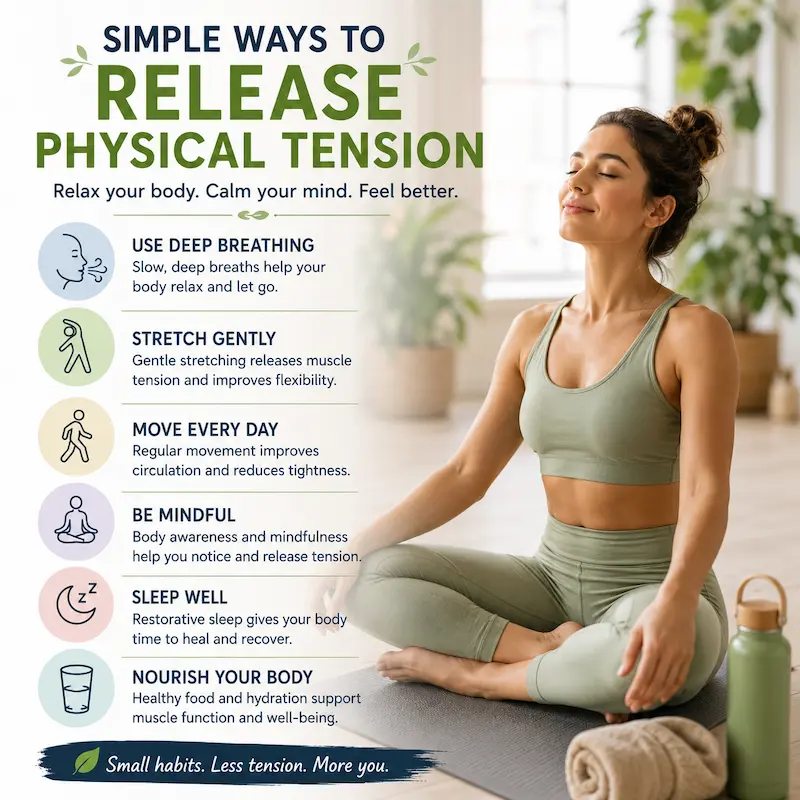
Daily Habits That Help Release Physical Tension
Learning how to release physical tension naturally is important, but preventing excessive tension from building up in the first place can be even more helpful. Small daily habits often have a greater long-term impact than occasional relaxation sessions because they reduce the amount of stress your body needs to manage every day.
The goal is not to eliminate all stress—that would be impossible. Instead, it is to create a lifestyle that allows your body to recover regularly instead of remaining in a constant state of alertness.
Take Short Movement Breaks
Many people spend hours sitting in the same position while working, studying, or using digital devices. Remaining still for long periods can increase stiffness in the neck, shoulders, back, and hips.
Try standing up every 30 to 60 minutes. Stretch gently, walk around the room, or simply change your posture for a few moments. These short breaks improve circulation and reduce the amount of tension that accumulates throughout the day.
Notice Your Posture Without Becoming Rigid
Good posture is helpful, but trying to sit perfectly straight all day often creates even more muscle tension.
Instead of aiming for a “perfect posture,” aim for a comfortable and balanced posture that allows your body to move naturally. Small adjustments throughout the day are usually more beneficial than remaining completely still.
Stay Hydrated
Water plays an essential role in many functions of the body, including healthy muscle function. Although dehydration is not usually the main cause of physical tension, staying well hydrated supports overall health and may help reduce muscle discomfort.
Drinking water regularly throughout the day is a simple habit that complements other healthy lifestyle practices.
Balance Activity and Rest
Exercise is beneficial, but so is recovery. A healthy balance between movement and rest allows your muscles and nervous system to recover without becoming overloaded.
Listen to your body’s signals. Some days may call for a longer walk, while others may require more rest and gentler movement. Learning to respect these changing needs is an important part of long-term well-being.
Be Patient With Yourself
Perhaps the most valuable habit of all is self-compassion.
Many people become frustrated when they continue experiencing physical tension despite trying different techniques. This frustration can create additional stress, making relaxation even more difficult.
Treat yourself with the same kindness you would offer a close friend. Your body is not failing—it is adapting to everything it has experienced. Recovery is often a gradual process rather than a single event.
Healthy Habits Help Release Physical Tension
Healthy daily habits work together to release physical tension more effectively than relying on a single relaxation technique. Gentle movement, restful sleep, balanced nutrition, hydration, and regular moments of calm all support your body’s natural recovery process.
Building small daily routines can also support long-term recovery. You may enjoy our guide on micro habits for stress relief.
How Long Does It Take to Release Physical Tension?
One of the most common questions people ask is how quickly physical tension will disappear. Unfortunately, there is no single answer because every person experiences stress differently.
Some people notice improvements after a few days of practising relaxation techniques, while others may need several weeks or even months before long-standing muscle tension begins to decrease.
The amount of time often depends on several factors, including:
- how long the tension has been present,
- overall stress levels,
- sleep quality,
- daily habits,
- physical activity,
- general health,
- consistency with self-care practices.
Rather than focusing on a specific timeline, it is often more helpful to pay attention to gradual improvements.
You may notice that your shoulders feel less tight after work, your breathing becomes deeper, or you wake up feeling slightly more refreshed. These small changes often indicate that your nervous system is beginning to feel safer.
Progress is rarely perfectly linear. Some days you may feel much better, while other days stress returns and muscle tension increases again. This does not mean you are starting over. Recovery often involves small ups and downs before lasting improvement becomes noticeable.
The important thing is to remain consistent with healthy habits instead of becoming discouraged by temporary setbacks.
Frequently Asked Questions About Physical Tension
Many people have questions about release physical tension, especially when symptoms have been present for a long time or seem to return repeatedly. The following answers address some of the most common concerns about stress-related physical tension and offer general information that may help you better understand your body’s natural response.
Can stress really cause physical tension?
Yes. Stress activates your body’s natural fight-or-flight response, preparing your muscles for action. When stress becomes chronic, muscles may remain partially contracted even when there is no immediate danger, leading to ongoing physical tension.
Why do my muscles stay tense even when I’m resting?
Your muscles may remain tense because your nervous system has not yet fully shifted out of its protective stress response. Physical rest is important, but your body also needs emotional safety, good sleep, and consistent recovery habits before it begins relaxing more completely.
Is physical tension always caused by stress?
No. Although stress is one of the most common causes, physical tension can also result from poor posture, repetitive movements, injuries, certain medical conditions, or other health-related factors. Persistent or unexplained symptoms should always be discussed with a qualified healthcare professional.
Can exercise help release physical tension?
Yes, gentle physical activity often helps reduce muscle tension. Walking, stretching, yoga, swimming, or other low-impact exercises may improve circulation, support healthy movement, and encourage your body to relax naturally. The best type of exercise is one that feels comfortable and sustainable for you.
Should I stretch every day?
Gentle daily stretching can be beneficial for many people, especially if tension commonly builds up in the neck, shoulders, back, or hips. The key is to stretch slowly and comfortably rather than forcing your muscles beyond their natural range of motion.
When should I seek professional advice?
If physical tension is accompanied by severe pain, numbness, weakness, loss of movement, unexplained symptoms, or persistent discomfort that interferes with your daily life, it is important to consult a qualified healthcare professional. They can help identify any underlying medical conditions and recommend appropriate treatment.
What Not to Do When You’re Feeling Tense
When people experience ongoing physical tension, their first instinct is often to look for the fastest possible solution. While this reaction is completely understandable, some common habits may actually make recovery more difficult.
Learning what not to do can be just as valuable as learning healthy relaxation techniques.
Don’t Force Your Body to Relax
Many people become frustrated when they cannot relax immediately. Ironically, trying too hard to relax often creates even more pressure.
Your nervous system cannot be forced into a calm state. Instead, it gradually responds to repeated experiences of safety, gentle movement, healthy breathing, and consistent self-care.
Be patient with yourself. Recovery is usually a gradual process rather than an instant change.
Don’t Ignore Persistent Stress
Physical tension is often your body’s way of communicating that something needs attention.
Ignoring ongoing stress, working without breaks, or constantly pushing yourself beyond your limits may allow tension to build even further.
Whenever possible, try to identify the situations, habits, or thoughts that regularly increase your stress levels. Small lifestyle adjustments made consistently are often more effective than waiting until symptoms become overwhelming.
Don’t Depend on Only One Technique
There is no single method that works for everyone.
Some people benefit most from breathing exercises, while others notice greater improvements through walking, stretching, mindfulness, or better sleep habits.
Instead of searching for the perfect solution, think about creating a combination of supportive daily habits that work well together.
Don’t Expect Every Day to Feel the Same
Recovery rarely follows a perfectly straight line.
Some days your body may feel lighter and more relaxed. On other days, stress may temporarily return and muscle tension may increase again.
These temporary setbacks do not mean you are failing or losing progress. They are simply part of the normal recovery process that many people experience.
When Physical Tension May Need Professional Support
Stress is one of the most common causes of physical tension, but it is not the only possible explanation.
If muscle tightness becomes severe, lasts for a long time, or is accompanied by symptoms such as significant pain, numbness, weakness, dizziness, fever, or loss of movement, it is important to seek medical advice.
A qualified healthcare professional can assess your symptoms, rule out underlying medical conditions, and recommend the most appropriate treatment for your individual situation.
Professional support may also be helpful if chronic stress, anxiety, or emotional difficulties are having a significant impact on your daily life. The World Health Organization (WHO) also highlights the importance of mental well-being and healthy lifestyle habits in supporting overall health.
Natural self-care practices can play an important role in supporting recovery, but they should complement—not replace—professional medical evaluation whenever it is needed.
Final Thoughts
Learning how to release physical tension naturally is not about fighting your body—it is about learning to work with it.
Your muscles are not your enemy. In many cases, they are simply responding to signals from a nervous system that has been trying to protect you through periods of stress, uncertainty, or emotional overload. Understanding this can change the way you relate to your body, replacing frustration with greater patience and compassion.
Recovery does not usually happen because of one perfect exercise or one extraordinary technique. More often, it grows from small choices repeated consistently over time. A few minutes of slow breathing, a gentle walk, better sleep, mindful stretching, or simply noticing when your shoulders begin to tighten can all become meaningful steps toward lasting change.
Remember that progress is rarely measured by the complete absence of tension. Instead, it often appears in subtle ways: breathing a little more deeply, sleeping more comfortably, feeling less stiffness at the end of the day, or recovering more quickly after stressful situations.
Every time you choose to care for your body with kindness instead of criticism, you are helping your nervous system learn that it is safe to relax again.
If muscle tightness has become a daily experience, our article on constant muscle tension offers additional guidance and practical insights.
With patience, consistency, and realistic expectations, it is possible to gradually release physical tension, support your body’s natural recovery processes, and move toward a greater sense of comfort, balance, and overall well-being.