Why is relaxation difficult after stress? Many people expect to feel calm as soon as a stressful situation ends, yet their body continues to feel tense, restless, or unable to fully relax. This experience is more common than you might think.
Many people ask themselves, why is relaxation difficult even when the stressful situation has already ended.
Stress affects more than the mind. It also affects the nervous system, muscles, and breathing. It can even change the way the body feels about safety. As a result, relaxation may feel surprisingly difficult, even when there is no immediate danger.
The good news is that nothing is wrong with you. In many cases, it simply means that your body needs time, support, and gentle practices to shift out of a stress response and into a state of recovery.
In this guide, we’ll explore why relaxation can feel difficult after stress and discover simple ways to help your body feel safe, calm, and balanced again.
Why Is Relaxation Difficult After Stress?
Stress activates the body’s natural survival response. When the nervous system perceives a threat, it prepares the body for action by increasing alertness, muscle tension, heart rate, and energy production.
The challenge is that the body does not always switch off this response immediately. Even after a stressful event has passed, the nervous system may remain in a heightened state of activation.
Why Is Relaxation Difficult When the Body Stays Alert?
After prolonged or repeated stress, the body can become accustomed to operating in “survival mode.” This can make relaxation feel unfamiliar or even uncomfortable.
People often report:
- Feeling tense without knowing why.
- Difficulty sitting still.
- Restlessness during quiet moments.
- Trouble falling asleep despite feeling tired.
In these situations, relaxation may feel difficult because the body has learned to expect stress rather than calm.
This may explain why some people continue experiencing chronic muscle tension and wonder why they feel tense all the time.
Stress Can Create Ongoing Muscle Tension
Stress often leads to unconscious muscle tightening, especially in areas such as:
- The shoulders.
- The neck.
- The jaw.
- The lower back.
Even when stress decreases, these patterns of tension may continue. As a result, the body may struggle to experience a genuine sense of relaxation.
If this sounds familiar, you may also find helpful information in our guide on physical signs of stress in the body.
Why Is Relaxation Difficult When the Nervous System Stays Alert?
The nervous system plays a central role in how safe or threatened the body feels.
Understanding why relaxation is difficult can help reduce frustration and encourage a more patient approach to recovery.
When stress is ongoing, the nervous system may remain focused on protection rather than recovery.
The American Psychological Association (APA) explains how chronic stress can affect both the mind and body over time.
Why Is Relaxation Difficult Even When You Want to Relax?
Many people blame themselves when they cannot relax. However, difficulty relaxing is often a protective response rather than a personal weakness.
The nervous system may simply be trying to keep you ready for challenges.
Understanding this can reduce frustration. It can also help you be more patient with your recovery.
Why Is Relaxation Difficult When Calm Feels Unfamiliar?
If stress has been present for a long time, calmness may feel unusual.
Some people even experience:
- Restlessness during relaxation exercises.
- Anxiety when trying to slow down.
- Discomfort during periods of silence.
This does not mean relaxation is harmful. It simply means the nervous system is adjusting to a different state.
You can learn more in our article about how to relax your nervous system naturally.
Signs Your Body May Still Be Recovering from Stress
The body often gives subtle signals that it is still processing the effects of stress.
Physical Signs
Common physical signs include:
- Tight muscles.
- Fatigue.
- Shallow breathing.
- Headaches.
- Digestive discomfort.
These symptoms do not always mean illness. Sometimes they show that the nervous system is still recovering.
Emotional Signs
Stress recovery can also involve emotional symptoms such as:
- Irritability.
- Feeling overwhelmed.
- Difficulty concentrating.
- Increased sensitivity.
These experiences often improve as the body gradually feels safer and more regulated.
Many people also benefit from understanding how to release stress from the body step by step.
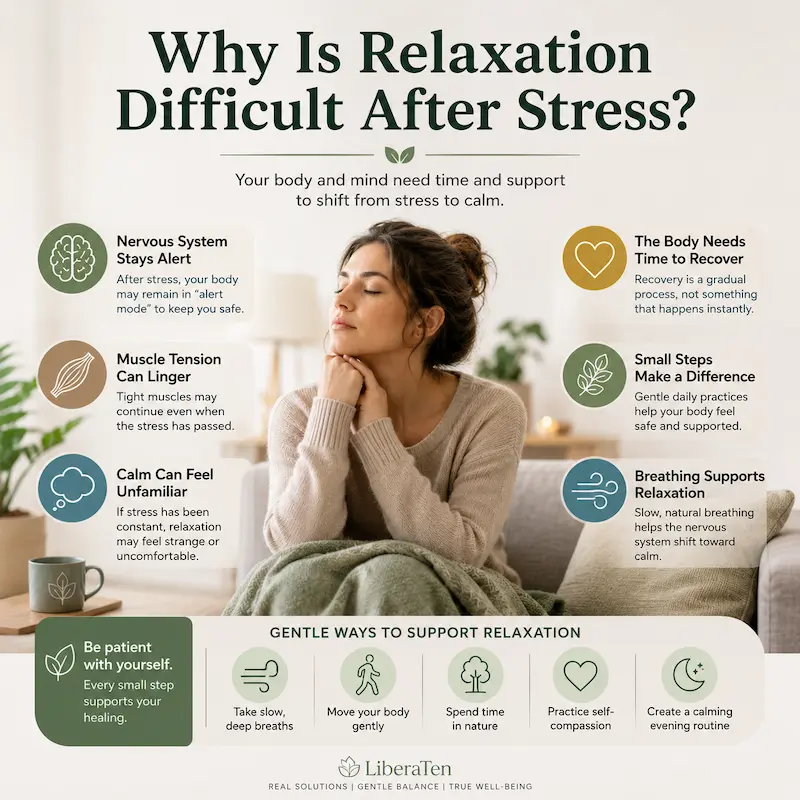
What Can You Do When Relaxation Feels Difficult?
Relaxation cannot always be forced. Instead, it often develops naturally when the body receives consistent signals of safety.
Small Ways to Help When Relaxation Feels Difficult
Rather than expecting immediate relaxation, look for small moments of comfort throughout the day.
Examples include:
- Taking a slow walk.
- Listening to calming music.
- Spending time in nature.
- Practicing gentle stretching.
These simple actions can help the nervous system feel supported.
Breathe Slowly and Naturally
Slow breathing can encourage the body to shift toward a calmer state.
The goal is not to control every breath but to create a gentle rhythm that feels comfortable and natural.
Give Yourself Time
Recovery from stress is often gradual.
Just as stress can build up over time, relaxation may also develop step by step.
During this transition, you may still feel tired while your body remains alert, especially after prolonged periods of stress.
If stress has been present for a long time, learning how to recover from chronic stress can help you understand why this process may take time and what can support your recovery.
Being patient with yourself is an important part of the healing process.
Conclusion
Why is relaxation difficult after stress? In many cases, the answer lies in the body’s natural protective responses. Stress can leave the nervous system activated, create ongoing muscle tension, and make calmness feel unfamiliar.
This may explain why your body never fully relaxes, even after a stressful period has ended.
The good news is that this state is usually temporary. By approaching recovery gently and consistently, you can help your body regain its sense of safety and gradually experience deeper relaxation again.
The process may take time, but every small step toward calm is a step toward greater balance, resilience, and well-being.